Warrior philosophy is the body of ideas that fighting people across history worked out about how to live: how to face fear and death, when force is right and when it is not, what a warrior owes to others, and how to come home from violence still a whole person. It was never one book or one school. It is a long conversation, carried on in epic poems, scriptures, field notebooks, knightly manuals and prison memories, between people who had to think hard about these questions because their lives depended on the answers.
This guide follows that conversation from Homer’s Troy to a prison in Hanoi, using the warriors’ own words wherever they survive. We are students of this tradition, not masters of it. We study these lives and codes because the warrior poet, someone who is both strong and thoughtful, is who we aspire to become, and warrior philosophy is the path toward that ideal.
The Short Answer
Warrior philosophy is the set of beliefs, codes and practices through which fighting cultures understood courage, duty, honor, death and the use of force. Some traditions put firm limits on violence, while others stressed loyalty, reputation, obedience or victory, and warriors did not always live up to the ideals they were taught. Its recurring themes are facing death without being ruled by fear, serving a duty larger than yourself, using force with restraint, mastering yourself through training, and telling the truth about war afterward.
Different cultures gave it different names. The samurai spoke of bushido, the “warrior way.” Medieval Europe spoke of chivalry. Ancient Greece had no single word for it, but its poems are full of it. Today’s military ethicists usually call it the warrior’s code or the warrior ethos. Underneath the names, the same handful of questions keeps coming back.
The Problem Every Warrior Code Tries to Solve
The clearest modern statement of why warrior philosophy exists comes from Shannon E. French, who taught a philosophy course called “The Code of the Warrior” at the U.S. Naval Academy. On the first day, she asked midshipmen whether any of five words, “murderer,” “killer,” “fighter,” “victor” and “conqueror,” were perfect synonyms for “warrior.” In her 2001 paper, she reports that her students consistently rejected all five, and that they rejected “murderer” with real emotion.
That reaction points at the core problem. Every society condemns murder, yet every society asks some of its people to kill on its behalf. As French puts it, warriors “must learn to take only certain lives in certain ways, at certain times, and for certain reasons. Otherwise, they become indistinguishable from murderers and will find themselves condemned by the very societies they were created to serve.” A warrior code is an attempt to draw that line. Whether it succeeds depends on the standards it sets, whose lives those standards protect, and whether warriors actually keep them.
French makes a second point that surprises many readers. The code is not only for the enemy’s sake. “One reason for such warriors’ codes may be to protect the warrior him- (or her-) self from serious psychological damage,” she writes. By holding to high standards, she argues, warriors “can create a lifeline that will allow them to pull themselves out of the hell of war and reintegrate themselves into their society.” She also offers a simple test for any culture that calls itself a warrior culture: ask “why they fight, how they fight, what brings them honor, and what brings them shame.”
French presents this as a likely purpose of warrior codes, not a guarantee. Keeping a code does not make anyone immune to guilt or trauma, as the modern research on moral injury, described below, makes clear.
Keep those four questions in mind. Every tradition below is one culture’s answer to them.
Eleven Traditions, One Conversation
The traditions below come from very different times and places, and they disagree with one another in important ways. We have chosen texts that preserve different ways of thinking about war, duty and character. Some were written by people who fought. Others are epics, scriptures, or accounts by observers and students. They do not all offer firsthand testimony, but together they show how different societies imagined, questioned and taught the warrior’s role.
Homer’s Greece: Honor That Has to Be Earned
The Iliad, attributed to Homer and composed sometime between the late eighth and mid-seventh century BC, is set in the last weeks of the Trojan War. In Book 12, the Lycian prince Sarpedon turns to his friend Glaucus before an assault on the Greek wall and explains why they, of all people, must go first. In Samuel Butler’s translation:
“Glaucus, why in Lycia do we receive especial honour as regards our place at table? Why are the choicest portions served us and our cups kept brimming, and why do men look up to us as though we were gods? … it becomes us, therefore, to take our stand at the head of all the Lycians and bear the brunt of the fight.”
What it means: Privilege is a debt, not a reward. Sarpedon’s people feed and honor him so that he will stand in front when danger comes. He goes on to say that since “death in ten thousand shapes hangs ever over our heads,” running from it buys nothing. It is an early and memorable expression of the idea that leaders owe the most risk, not the least.
Greek culture also produced the hardest version of this ideal and its most honest rebuttal. Plutarch records a Spartan mother handing her son his shield with the words “Either this or upon this,” meaning come home carrying it, or be carried home on it. Yet the soldier poet Archilochus wrote openly about throwing his shield away to save his life, and he did not apologize. Both voices are part of warrior philosophy. The tradition has always argued with itself.
Socrates: The Soldier Who Would Not Leave His Post
Socrates is remembered as a philosopher, but he also served Athens as a soldier. At his trial in 399 BC, as Plato records it in the Apology, he reminded the jury that he had held his position when the generals placed him “at Potidaea and Amphipolis and Delium.” Then he drew a line from the battlefield to the life of the mind:
“For wherever a man’s place is, whether the place which he has chosen or that in which he has been placed by a commander, there he ought to remain in the hour of danger; he should not think of death or of anything, but of disgrace.”
What it means: Socrates argues that his duty to question himself and others is a post, like the one he held in battle, and that abandoning it out of fear of death would be the same failure as deserting the line. He chose to stay, and the court sentenced him to death. In one speech, he turns the soldier’s virtue of steadiness into a philosophical one. That move, from the battle line to the inner life, runs through almost everything that follows.
The Bhagavad Gita: Duty Without Attachment
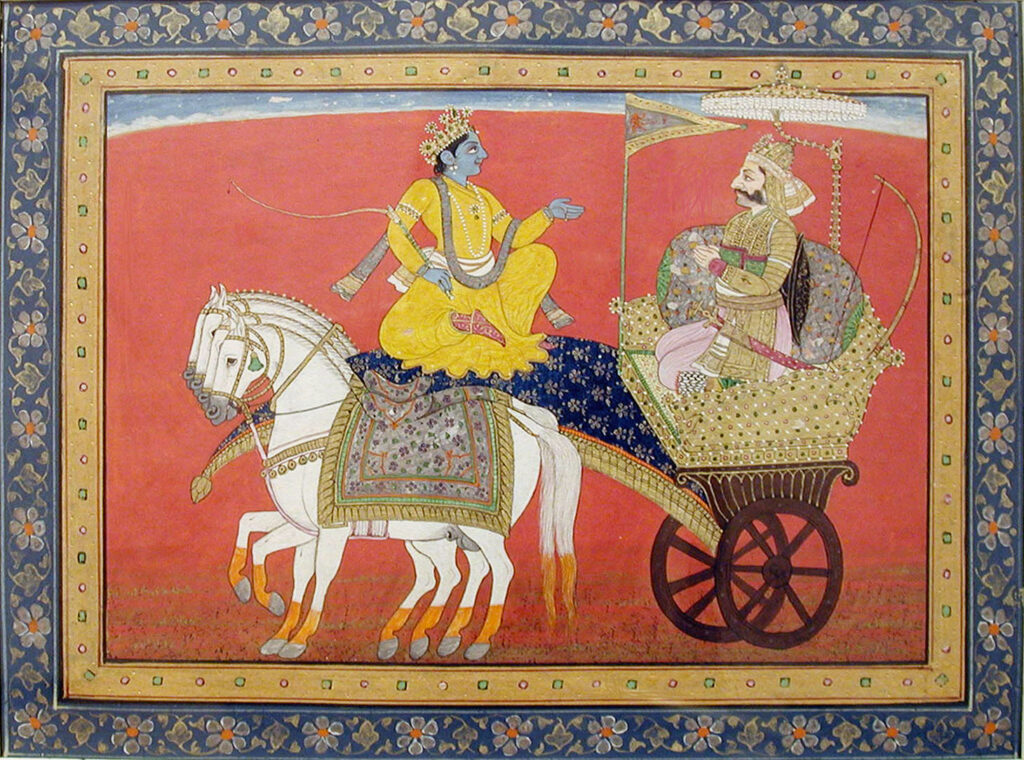
The Bhagavad Gita, part of the Indian epic the Mahabharata and likely composed in the second or first century BCE, although its date is debated, opens on a battlefield. The archer Arjuna sees friends, teachers and relatives in the opposing army and loses the will to fight. In Edwin Arnold’s verse translation, he says “I will not fight!” and falls silent, while “the Prince wept despairing ‘twixt those hosts.”
His charioteer, the god Krishna, answers with a long teaching about duty, or dharma. Its most quoted lines, in Arnold’s version:
“Let right deeds be / Thy motive, not the fruit which comes from them. / And live in action! Labour! Make thine acts / Thy piety, casting all self aside”
What it means: Krishna does not simply tell Arjuna to be brave. He teaches him about dharma, the obligations that come with his place in the world, and about acting without attachment to personal reward, inside a larger discussion of the self, death and devotion to the divine. Later readers have understood the battlefield both as part of a sacred story about duty and as a picture of the inner struggle every person faces. Neither reading erases the hard question the poem opens with: whether Arjuna should fight people he loves. Its central idea, act fully while releasing attachment to results, became one of the most influential ideas in Indian thought.
Sun Tzu: The Victory That Needs No Battle
The Art of War, attributed to Sun Tzu and traditionally dated to roughly the fifth century BC, although scholars debate when it took its final form, is usually shelved as a strategy manual. Read closely, it also argues for a kind of restraint. Its first lines, in Lionel Giles’s translation, call war “a matter of life and death, a road either to safety or to ruin.” Later it warns that “there is no instance of a country having benefited from prolonged warfare.” Then comes its most famous claim:
“Hence to fight and conquer in all your battles is not supreme excellence; supreme excellence consists in breaking the enemy’s resistance without fighting.”
What it means: The highest skill is winning without a costly battle. This is not pacifism. The same book states that “All warfare is based on deception,” and its restraint is mainly strategic: it aims to win while spending as few lives, resources and days as possible. Sun Tzu also values self-knowledge as highly as knowledge of the enemy: “If you know the enemy and know yourself, you need not fear the result of a hundred battles.” Even so, a reader who takes this text seriously learns to count the destruction a victory costs.
The Mohists: Defending Without Conquering
Sun Tzu was not China’s only answer to the problem of war. The followers of Mozi, a thinker active around 430 BC during the Warring States era, condemned unprovoked military aggression and tried to talk warlike rulers out of attacking their neighbors. They were not pacifists. According to the Stanford Encyclopedia of Philosophy, many Mohists concluded that they had a duty to help the victims of aggression, and some became specialists in defensive warfare, “rushing to the aid of cities and states under threat of attack.”
What it means: The Mohists put a different question beside Sun Tzu’s. He asked how to win. They asked when fighting is justified at all, and their answer was to fight only in defense of others. They are an early example of people who trained for war in order to make conquest fail.
The Norse: A Name That Outlives the Body
The Hávamál, the “Words of the High One,” is a collection of Old Norse wisdom verses attributed to the god Odin. It survives in a medieval manuscript, one scholarly estimate dates the poem to between 900 and 1000 AD, and it is considered an important source of Old Norse philosophy. It is not a formal warrior code. Much of it is practical advice for living and proper conduct, but two of its stanzas, in Henry Adams Bellows’s translation, are among the most quoted lines in Norse literature:
“Cattle die, and kinsmen die, / And so one dies one’s self; / But a noble name will never die, / If good renown one gets.”
What it means: Everything you own and everyone you love will pass, and so will you. What remains is the memory of how you lived. Another stanza makes the same point from the other side: “The sluggard believes he shall live forever, / If the fight he faces not.” Avoiding every hard thing does not buy immortality, only a smaller life. The poetry attributed to the Viking warrior Egil Skallagrímsson shows the same concern with reputation, alongside a grief that no reputation can cure.
Futuwwa: The Chivalry of Generosity
The medieval Islamic world developed its own ideal of noble conduct, called futuwwa, an Arabic word meaning roughly “young-manliness.” By the eighth century it had come to mean something like a moral code, drawing on both Arab and Persian traditions, and Persia had a closely related ideal called javanmardi. Futuwwa looked back to the pre-Islamic poet Hatim al-Tai, famous for his generosity, and to Ali ibn Abi Talib as models of the ideal young man. Brotherhoods built around futuwwa came to hold religious, military and political influence across much of the Islamic world, and in 1182 the caliph al-Nasir was himself initiated into the movement.
What it means: Futuwwa tied noble conduct to generosity and hospitality as much as to strength. Its history is a reminder that the ideal of the noble fighter was not a European invention, and that in many cultures the measure of such a man included how he treated his guests, not only how he fought.
Chivalry: Geoffroi de Charny and the Knight’s Restraint
The French knight Geoffroi de Charny, who lived from about 1306 to 1356, fought for France in the early years of the Hundred Years’ War and was one of the most admired knights in Europe during his lifetime. A contemporary chronicler, the abbot Gilles le Muisit of Tournai, wrote that in all his battles he conducted himself “with probity and with nobility.” Charny wrote a semi-autobiographical poem and a set of questions on jousting and war for a French order of knights, the Company of the Star. A prose Book of Chivalry has long been credited to him, although recent research suggests it was more likely written by his son of the same name.
The most striking evidence of Charny’s philosophy is not a text but a moment. Before the Battle of Poitiers in 1356, leaders of both armies met to negotiate. When the talks failed, according to the herald of the English knight Sir John Chandos, Charny proposed that a hundred chosen men from each side fight in place of the armies, so that, in his words, “God will be gracious to us if the battle be avoided in which so many valiant men will be slain.”
His proposal was refused. In the battle that followed, Charny carried the Oriflamme, the sacred battle standard of France, a post that made him a target, and he was killed holding it. His offer was not a rejection of fighting. It was an attempt to settle the contest with a smaller, chosen combat, in keeping with chivalric ideas about how disputes should be resolved. Still, his recorded words show courage, honor and the wish to limit bloodshed living in the same person, without making medieval war humane.
Chivalry was also judged by people who did not fight. In 1410 the writer Christine de Pizan published The Book of Feats of Arms and of Chivalry, written in French so that soldiers without Latin could read it. She opened with the theory of just war, discussed what she called the laws of war, including the treatment of noncombatants and prisoners, and opposed trial by combat. Her book is a reminder that a warrior code can be measured by those who bear the consequences of war as well as by those who wage it.
The Sikh Saint-Soldier: Spiritual and Temporal Duty
In the early seventeenth century, Guru Hargobind, the sixth Sikh Guru, took up two swords after the execution of his father, Guru Arjan Dev. The swords, called miri and piri, stood for worldly and spiritual authority, and the pairing gave rise to the ideal of the sant sipahi, or saint-soldier. The tenth Guru, Guru Gobind Singh, strengthened the ideal when he founded the Khalsa. A saint-soldier is meant to have the wisdom of a saint and the courage of a warrior, to be ready to defend the innocent, and never to use martial skill for material gain or personal glory.
What it means: The saint-soldier ideal refuses to separate the spiritual life from the duty to protect. It may be the clearest expression in any tradition of the balance this site cares about, holding inner devotion and outer courage together, with personal glory ruled out from the start.
Bushido: Death, Training and a Code Written in Peacetime
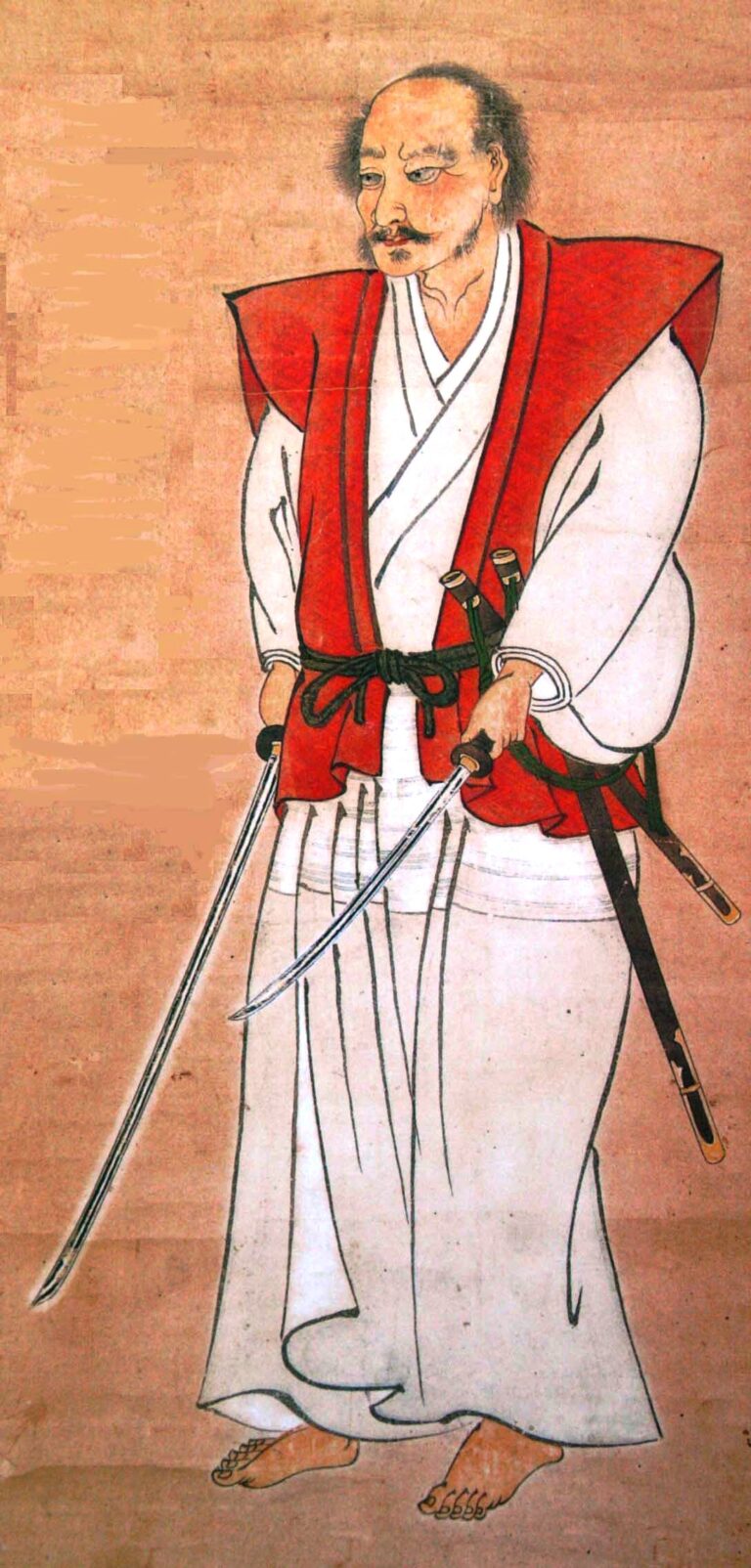
Bushido, the “warrior way,” is probably the most famous warrior philosophy in the world, and also one of the most misunderstood. One of the earliest known uses of the word is in the Kōyō Gunkan, a military chronicle assembled in the early seventeenth century. The best known bushido text, the Hagakure, was compiled by Tashiro Tsuramoto from conversations with Yamamoto Tsunetomo between 1709 and 1716. It contains the famous saying that “the way of the warrior is death.”
That line is sometimes read as a simple cult of dying, and sometimes softened into a modern reminder to live fully. Neither captures it. Tsunetomo asks the samurai to be willing to die at any moment in loyalty to his lord, and argues that constant awareness of death removes hesitation, so that, in the words of one summary, “it is possible to perfectly fulfill one’s calling as a warrior.” It is a demanding philosophy of commitment, and it also raises hard questions about obedience and the value of a life. It represents one strand of samurai thought, not a rule every samurai followed. The surprising part is who wrote it. Japan had been largely at peace since 1638, and Tsunetomo, born in 1659, had no personal combat experience and worked as a scribe. The Hagakure is partly an old retainer’s nostalgia for a warrior world that had vanished before he was born.
The swordsman Miyamoto Musashi offers a different flavor. His Book of Five Rings, written between 1643 and 1645, closes its first section with nine principles for his students, including “Do not think dishonestly,” “The Way is in training,” “Become acquainted with every art,” and “Do nothing which is of no use.” A week before he died in 1645, while giving away his possessions, Musashi wrote the Dokkōdō, “The Way of Walking Alone,” a list of 21 austere precepts for his favorite student.
Much of what the modern world thinks of as bushido comes from a later source. Nitobe Inazō’s Bushido: The Soul of Japan, written in English in 1899 and published in the United States at the turn of the twentieth century, brought the term into common international use and presented it as a set of moral virtues. Nitobe himself called it “a code unuttered and unwritten,” and historians now regard his version as a romanticized interpretation that does not represent all of samurai thought. The Hagakure, meanwhile, was largely forgotten for two centuries and only came to be treated as the definitive samurai text by Japan’s armed forces during the Pacific War. Knowing that history does not make bushido less worth studying. It makes our study more honest.
Stoic Soldiers: From Marcus Aurelius to Stockdale
Stoicism was not a warrior philosophy in origin, but it has been tested on campaign and in captivity more than almost any other. Marcus Aurelius, the Roman emperor, wrote the private notebooks we call the Meditations during the years he spent directing the Marcomannic Wars. The text carries two place notes tied to his campaigns, “Among the Quadi at the Granua,” a river in what is now Slovakia, and Carnuntum. Scholars debate exactly which books they belong to, but they place at least part of the work in the setting of his wars. In George Long’s translation, he wrote:
“The art of life is more like the wrestler’s art than the dancer’s, in respect of this, that it should stand ready and firm to meet onsets which are sudden and unexpected.”
What it means: Marcus compares the art of living to wrestling because both demand readiness for the unexpected. His concern is not defeating other people, but keeping his judgment and composure when circumstances change without warning.
Eighteen centuries later, James Stockdale, a U.S. Navy pilot who had been introduced to the Stoic teacher Epictetus as a graduate student at Stanford, was shot down over North Vietnam on September 9, 1965. In his 1993 lecture “Courage Under Fire,” he recalled what he whispered to himself as he parachuted toward a village: “I’m leaving the world of technology and entering the world of Epictetus.” He spent more than seven years as a prisoner, much of it as the senior naval officer among the prisoners in Hanoi, and later received the Medal of Honor for his leadership. He described how, from the moment he ejected, he relied on Epictetus’s habit of keeping separate “files” for what is “up to him” and what is “not up to him” in his mind. With a badly broken leg, he took comfort in another of Epictetus’s lines: “Lameness is an impediment to the leg, but not to the Will.”
Five Questions That Return Across Every Tradition
Set side by side, these traditions disagree about a great deal, including gods, honor, revenge and the meaning of death. They do not share one moral code. But certain questions come back again and again, in cultures that never met, even when the answers differ. These five are our own way of comparing the texts above, not a claim that every tradition taught the same thing.
1. What should a warrior do with the fear of death? Sarpedon reasons that death “hangs ever over our heads” anyway. The Hávamál says everyone dies and only the name remains. Socrates tells his jury that a man at his post “should not think of death or of anything, but of disgrace.” The Hagakure goes furthest, asking for readiness to die at any moment. Most of these teachings ask a person to stop letting the fear of death make their choices, and the hardest of them ask for much more.
2. What does a warrior owe to others? Sarpedon’s privilege obliges him to stand in front. Socrates will not abandon the post a commander, or a god, assigned him. Krishna tells Arjuna to act rightly without craving the fruits. The saint-soldier may never fight for personal glory. Warrior philosophy rarely treats the self as the point, although it often disagrees about who the warrior’s duty is owed to.
3. When is force justified, and what should limit it? Sun Tzu ranks victory without a costly battle above every battle won. The Mohists fought only to defend. Charny offered a smaller combat to spare an army, and Christine de Pizan wrote about protecting noncombatants and prisoners. French’s midshipmen insist that a warrior is never a murderer. The answers vary, and some traditions drew the limits far too narrowly, but the serious ones all ask the question.
4. How can a person govern fear, anger and desire? Musashi wrote “The Way is in training.” Marcus compared the art of living to wrestling. Stockdale had studied Epictetus for years before he needed him. The battle that warrior philosophy cares about most is often the one inside.
5. What remains after the fighting ends? The Hávamál prizes the name that survives a person, which is to say the story told about them. Archilochus told the unflattering truth about his shield. The psychiatrist Jonathan Shay, who worked with Vietnam veterans, argued that healing comes when a survivor’s experience is “understood, remembered and retold with enough fidelity to carry some of this truth.” This is where the warrior and the poet meet.
What Warrior Philosophy Is Not
Because the word “warrior” sells everything from energy drinks to workout programs, it is worth being clear about what this tradition does not mean.
It is not a celebration of violence, but its history is not uniformly peaceful either. Some traditions praised restraint and mercy. Others demanded vengeance, sacrifice or unquestioning loyalty. The gap between what warriors were taught to admire and what they actually did is part of what makes these traditions worth studying. It is not one ancient, unchanging code. Bushido as most people imagine it was shaped in peacetime and popularized around 1900, and the chivalric ideal was argued over by the knights who lived it. It is not toughness for its own sake. Arjuna weeps and lays down his will to fight, and Archilochus runs. The tradition is full of people who were afraid and acted well anyway. Finally, it is not only for soldiers. Socrates applied the soldier’s steadiness to a life of questioning, and Marcus applied it to the daily work of being a decent person.
Warrior codes also did not exist only in the minds of warriors. Their consequences fell on captives, civilians, families and defeated enemies, and an ideal that seemed honorable inside one warrior community might offer little protection to anyone outside it. Understanding a code means asking whose interests it served, whose conduct it governed, and whose suffering it overlooked.
Famous Lines That Warriors Never Said
Warrior philosophy attracts misquotations the way old battlefields attract legends. Three of the most common:
“The society that separates its scholars from its warriors will have its thinking done by cowards and its fighting done by fools.” This is constantly credited to Thucydides, but it does not appear in his work. It is a reworded version of a line from Sir William Francis Butler’s 1889 biography of Charles George Gordon: “The nation that will insist on drawing a broad line of demarcation between the fighting man and the thinking man is liable to find its fighting done by fools and its thinking done by cowards.” Butler’s original is still one of the best arguments for the warrior poet ideal, and it deserves to be quoted correctly.
“Of all manifestations of power, restraint impresses men the most.” Also credited to Thucydides, and also not his. It traces to the nineteenth-century scholar F. B. Jevons, who was writing about prose style, and it was later quoted without attribution in the introduction to a translation of Thucydides, which is probably how the confusion began.
“Only the dead have seen the end of war.” General Douglas MacArthur attributed this to Plato, but the earliest known source is the philosopher George Santayana, who did not attribute it to anyone.
Warrior Philosophy Today
The conversation did not end with the samurai. Shannon French’s book The Code of the Warrior traces warrior codes across cultures for a modern audience, and Stockdale’s lecture is published as a short book by the Hoover Institution. Jonathan Shay’s books Achilles in Vietnam (1994) and Odysseus in America (2002) compared the experiences of Vietnam veterans with Homer’s epics, and Shay and his colleagues are credited with coining the term “moral injury” for the wound that comes from “a betrayal of what is morally right” by someone in authority in a high-stakes situation. Later researchers broadened the definition, but Shay’s remains one of the most influential.
Shay’s work brings us back to Homer in an unexpected way. The anger, grief and broken trust in the oldest text in this guide turn out to illuminate experiences that modern veterans have struggled to describe. French emphasizes that a code of conduct may help warriors keep their moral identity. Shay emphasizes the need for painful experience to be heard and understood. Together, their work shows that warrior philosophy has to ask not only how people prepare for violence, but also what happens to them afterward.
Why the Warrior Poet Is the Ideal
For this site, the warrior poet is one way of bringing all these traditions into conversation. We do not claim that every warrior culture shared this ideal. It is the perspective from which we study them. If warrior philosophy is the path, the warrior poet is where we hope the path leads: a person who can act with courage and also reflect with honesty, who has strength and also tenderness, and who can carry hard experience without being hardened by it. Butler’s real sentence says it plainly. A people that separates “the fighting man and the thinking man” ends up with fools and cowards. Musashi said it in his own way when he urged his students to “become acquainted with every art.”
That is why this site studies both the codes and the lives. The codes tell us what warriors believed. The lives, from King David to Archilochus to Egil, show what it cost to live by those beliefs. If you are new to the idea, our guide What Is a Warrior Poet? is the place to start.
The Lessons We’re Training to Live By
We are not warriors in the sense these people were, and we do not pretend to be. Some of their choices remain troubling, and others are hard to understand outside the worlds they lived in. What draws us to them is not their perfection, but the record of people trying to reconcile action, duty and conscience under extraordinary pressure. These are the lessons we are training to live by, in mind and body, taken from their stories.
- Stand where you have been placed. Socrates held his post at Delium and then held his post as a philosopher. The posts in our own lives are smaller, but the steadiness is the same.
- Do the right thing and release the result. Krishna’s teaching to Arjuna is the hardest one on this list for us, and the one we return to most.
- Keep two files. Stockdale sorted everything into what was up to him and what was not, even in a cell. We try to make that sort before reacting.
- Make the fight unnecessary when you can. Sun Tzu and Charny both prized the battle avoided. Most of our battles are arguments, and the same wisdom applies.
- Train, because the moment will not wait. “The Way is in training,” Musashi wrote. Marcus’s wrestler has to be ready before the onset, not after.
- Tell the truth about the hard parts. Archilochus admitted he ran. Shay found that honest retelling helps people heal. A warrior poet’s work is to tell it straight.
A Timeline of Warrior Philosophy
This table lists the texts and moments covered in this guide, using the dates scholars generally accept. Ancient dates are approximate.
| Date | Text or Event | Tradition |
|---|---|---|
| Late 8th to mid-7th century BC | Homer’s Iliad | Ancient Greece |
| Traditionally 5th century BC | Sun Tzu’s The Art of War | Ancient China |
| About 430 BC | Mozi active, founder of the Mohist school | Ancient China |
| 399 BC | Socrates’s trial, recorded in Plato’s Apology | Ancient Greece |
| Likely 2nd or 1st century BCE | Bhagavad Gita, part of the Mahabharata | Ancient India |
| About 170 to 180 AD | Marcus Aurelius’s Meditations, written partly on campaign | Roman Stoicism |
| About 900 to 1000 AD (one estimate) | Hávamál, Old Norse wisdom poem | Norse |
| 1182 | Caliph al-Nasir initiated into the futuwwa | Islamic world |
| 1356 | Geoffroi de Charny killed at Poitiers carrying the Oriflamme | Chivalry |
| 1410 | Christine de Pizan’s Book of Feats of Arms and of Chivalry | Chivalry |
| Early 17th century | Guru Hargobind’s two swords of miri and piri | Sikh |
| Early 17th century | Kōyō Gunkan, with one of the earliest uses of the word bushido | Japan |
| 1643 to 1645 | Musashi’s Book of Five Rings and Dokkōdō | Japan |
| 1709 to 1716 | Hagakure compiled from Yamamoto Tsunetomo’s conversations | Japan |
| 1899 to 1900 | Nitobe Inazō’s Bushido: The Soul of Japan | Japan, for Western readers |
| 1965 to 1973 | James Stockdale’s captivity in North Vietnam | Modern Stoicism |
| 1993 | Stockdale’s lecture “Courage Under Fire” | Modern Stoicism |
| 1994 | Jonathan Shay’s Achilles in Vietnam | Modern military ethics |
Where to Start Reading
If this guide makes you want to read the sources themselves, here is where we would begin. Some are short and some are long, but each rewards rereading.
- Homer, Iliad, Book 12. Sarpedon’s speech is a few lines, but the whole book shows the cost of the honor he describes.
- Plato, Apology. A short, readable speech by a veteran on trial for his life.
- Bhagavad Gita. Edwin Arnold’s verse translation is free online, and many modern translations exist.
- Sun Tzu, The Art of War. Lionel Giles’s translation is the classic public domain version.
- Hávamál. Henry Adams Bellows’s translation is in his Poetic Edda.
- Marcus Aurelius, Meditations. George Long’s translation is free, and modern ones are easier to read.
- Miyamoto Musashi, The Book of Five Rings. Read the Earth book and its nine principles first.
- Christine de Pizan, The Book of Feats of Arms and of Chivalry. A medieval writer’s view of the laws of war.
- Richard W. Kaeuper and Elspeth Kennedy, The Book of Chivalry of Geoffroi de Charny. The standard scholarly translation, with context.
- James B. Stockdale, Courage Under Fire. A short lecture, published by the Hoover Institution.
- Shannon E. French, The Code of the Warrior. A modern survey of warrior codes across cultures, by a Naval Academy ethics professor.
- Jonathan Shay, Achilles in Vietnam. Homer read alongside the testimony of modern veterans.
Keep Exploring
These guides and profiles on the site go deeper into the people and ideas in this article.
- What Is a Warrior Poet? Meaning, History and Examples
- The Warrior Poet: A History from Ancient Greece to the Trenches
- The Warrior Poet Archetype Explained
- Famous Warrior Poets: 40 Who Went to War and Wrote
- Archilochus: The Greek Soldier Poet Who Lost His Shield
- Egil Skallagrímsson: Viking Warrior and Skald
- King David: Shepherd, Warrior, King and Psalmist
- Warrior Poet Quotes: 18 Verified Lines from Soldiers Who Wrote
FAQ
These are the questions readers most often ask about warrior philosophy, answered briefly.
What Is Warrior Philosophy in Simple Terms?
It is the set of ideas warriors across history developed about how to live, face death, use force with limits and serve something larger than themselves. It appears in texts as different as Homer’s Iliad, the Bhagavad Gita, the Hagakure and the notebooks of Marcus Aurelius.
Is Warrior Philosophy the Same as Stoicism?
No. Stoicism is one Greek and Roman school that many warriors found useful, from Marcus Aurelius on campaign to James Stockdale in Hanoi. Warrior philosophy is broader and includes traditions like bushido, chivalry and the Bhagavad Gita that have nothing to do with the Stoics.
What Is the Warrior Code?
A warrior code is the set of rules and ideals a culture uses to separate its warriors from mere killers. Shannon French argues that these codes can protect the enemy and the warrior alike, because they help warriors keep their self-respect and return to ordinary life. Codes did not always live up to that purpose, and some protected only insiders. Not every code was written down, and many were passed on through stories and example.
Is Bushido a Real Historical Code?
Partly. Samurai did write about warrior conduct, and the word bushido appears in the early seventeenth century. But there was never one official bushido code, and the version most people know was shaped by peacetime writers like Yamamoto Tsunetomo and popularized internationally by Nitobe Inazō around 1900.
Do You Have to Be a Soldier to Follow Warrior Philosophy?
No. Socrates applied the soldier’s steadiness to a life of philosophy, and the Bhagavad Gita has long been read as a guide to inner struggle. Most people who study warrior philosophy today, including us, use it to face ordinary fears, duties and hardships with more courage.
What Is the Best Book to Start With?
For a single short read, Plato’s Apology or Stockdale’s Courage Under Fire shows warrior philosophy in action. For a survey across cultures, Shannon French’s The Code of the Warrior is a good modern guide.
Sources
- Shannon E. French, “The Warrior’s Code” (U.S. Naval Academy, 2001)
- Homer, Iliad Book 12, trans. Samuel Butler (Internet Classics Archive)
- Plato, Apology, trans. Benjamin Jowett
- Bhagavad Gita, Chapter 2, trans. Edwin Arnold
- Sun Tzu, The Art of War, trans. Lionel Giles
- Hávamál, trans. Henry Adams Bellows
- Plutarch, Sayings of Spartan Women (Loeb, LacusCurtius)
- Marcus Aurelius, Meditations, trans. George Long
- James B. Stockdale, “Courage Under Fire” (1993 lecture, reprinted by CUNY)
- Hoover Institution, Courage Under Fire
- Stanford Encyclopedia of Philosophy, “Mohism”
- Wikiquote, Thucydides (misattributed quotations)
- Wikiquote, Plato (misattributed quotations)
- Plus the Wikipedia article on each person and text named, including Hagakure, Bushido, Geoffroi de Charny, Christine de Pizan, Futuwwa, Sant Sipahi, Jonathan Shay and Moral injury.