Egil Skallagrímsson was an Icelandic Viking warrior and skald, or poet, who lived in the tenth century and is the hero of Egil’s Saga. The saga presents him as a fierce and difficult man who fought in raids and battles, saved his own life with a poem, and, after the death of his sons, composed Sonatorrek, a lament that scholars count among the most admired skaldic poems ever made.
| Lived | The tenth century, in Iceland, Norway and England; estimates of his exact dates vary |
| Known for | Viking raids, fighting for King Æthelstan of England, and his feud with King Eirík Bloodaxe |
| The hardship | A death sentence at the court of his worst enemy, and the loss of two sons |
| Key work | Two poems the saga attributes to him, Höfuðlausn (Head-Ransom) and Sonatorrek (The Loss of Sons) |
Timeline
The dates below come from the saga and from modern estimates, and most are approximate.
| About 904 | Born in Iceland, where his father, Skalla-Grímr, had settled the farm of Borg |
| Age 3 | Composes his first poem, according to the saga |
| Age 7 | Kills a boy after a quarrel over a ball game |
| Young manhood | Raids along the eastern route with his brother Þórólfr, and begins his feud with Eirík Bloodaxe and Gunnhildr |
| Middle years | Fights for King Æthelstan at the battle the saga calls Vínheiðr, widely identified with the Battle of Brunanburh in 937; Þórólfr is killed |
| Later | Shipwrecked in England, he saves his life at York by composing Höfuðlausn, in a single night according to the saga |
| Later life | Loses his sons Böðvarr and Gunnar, and composes Sonatorrek |
| Late tenth century | Dies, blind, in old age, shortly before Iceland becomes Christian |
Who Egil Was
Egil was born in Iceland in the early tenth century, around 904 by one common estimate. His father was Skalla-Grímr, and his grandfather was Kveld-Úlfr. He had a brother, Þórólfr, who would fight beside him.
The saga makes him a prodigy in both of the skills that defined him. It says that he composed his first poem at the age of three. It also says that at seven, after another boy got the better of him in a ball game, Egil struck him with his bat and was thrown to the ground. He came back later with an axe and killed the boy. The story is meant to shock, and it sets the tone for a hero who is gifted, proud, and dangerous.
Most of what we know about Egil comes from Egil’s Saga, which was written in Iceland between about 1220 and 1240, more than two centuries after his death. Scholars think the poems in it may have been composed by a real Egil and passed down by word of mouth, with the saga built around them, giving the story what one view calls “a spine of historical truth.” The details of his life should be read with that in mind.
War and a Death Sentence
As a young man, Egil went raiding with Þórólfr along the eastern route, where they won great wealth and fought many battles. Later, according to the saga, both brothers fought for King Æthelstan of England in a great battle that is usually identified with the Battle of Brunanburh. Þórólfr was killed there, and the saga says Æthelstan gave Egil two chests of silver to take home to his father, as payment for the loss of a son.
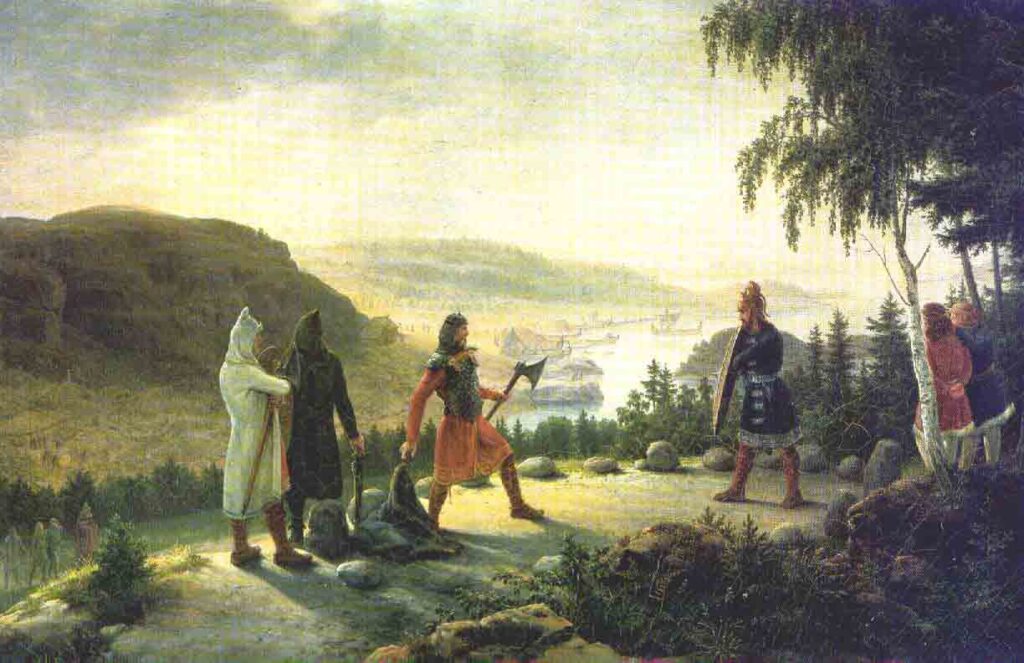
Egil’s most dangerous enemy was Eirík Bloodaxe, a king of Norway, and his queen, Gunnhildr. The saga tells how Egil killed men close to the royal couple, including Bárðr, a steward who was much prized by Eirík and Gunnhildr, and later their son, Rögnvaldr. He even raised a “nithing pole,” a pole set up to curse the king and queen.
Years later, Egil ended up in the hands of the very man he had cursed. According to the saga, he was shipwrecked on the English coast and found that Eirík was ruling from York, in northern England, and he went to the king’s court. Eirík told him to expect nothing but death.
How He Endured
Egil survived that night with the help of a friend and the gift that made him famous. His friend Arinbjörn, who served King Eirík, spoke on his behalf and persuaded the king to wait until morning, arguing, in W. C. Green’s translation of the saga, that “night-slaying is murder.” The saga claims that during that single night, Egil composed Höfuðlausn, or “Head-Ransom,” a praise poem of twenty stanzas for the king who wanted him dead. The next day he recited it. “Right well was the poem recited,” Eirík said, in Green’s translation, and he granted Egil his life, crediting Arinbjörn’s pleading and the fact that Egil had come freely into his power. He also made it clear that this was no reconciliation, and ordered Egil never to come before him again.
The harder test came later, back home in Iceland. His son Böðvarr drowned in a storm, and another son, Gunnar, died of a fever. The saga describes the scene after the drowning in detail. “The end was that the boat sank under them, and all were lost,” it says. Egil found his son’s body, carried it to his father’s burial mound, and laid it there. Then he went straight to his bed-closet, locked himself in, and refused food and drink, determined to die.
His daughter Þorgerðr saved him. She came to him and declared, “I will not overlive my father and brother,” and lay down on another bed in the room, as if she, too, meant to starve. She then tricked him into drinking milk, and once he had broken his fast, she urged him to compose a funeral poem for Böðvarr, which she would carve on wood. As he worked on the poem, the saga says, “Egil began to cheer up,” and when it was finished, he rose from his bed and took his place again in the high-seat of his hall.
He lived to a great age. The saga says he grew blind in old age, and that he died shortly before Iceland became Christian.
In His Own Words
The saga preserves many of the poems it credits to Egil. The translations below are from W. C. Green’s 1893 English version of the saga, unless noted.
The Poem That Saved His Life
Höfuðlausn, the Head-Ransom, opens with Egil describing how he launched his ship as the ice broke up and sailed west over the sea, his mind loaded like a ship with poetry, the gift of Óðinn. In Green’s translation:
“My mind a galleon fraught
With load of minstrel thought.”
The rest of the poem praises the king.
What it means: Facing death, Egil used the one weapon that might work: praise, made with such skill that even an enemy king would want to hear it to the end.
Sonatorrek: The Loss of Sons
The poem Egil made for his sons is Sonatorrek, a skaldic poem of twenty-four or twenty-five stanzas, depending on the edition, whose title is commonly translated as “the irreparable loss of sons.” Scholars have called it “the first purely subjective lyric in the North.” It opens with the struggle to speak at all:
“Much doth it task me
My tongue to move,”
What it means: Grief has left him almost unable to speak, let alone compose. The poem begins by admitting it.
Margaret Clunies Ross’s modern translation (2022) renders the same lines more plainly:
“It is very hard for me
to move my tongue”
Óðinn’s Gift
The poem moves through his grief, the end of his family line, and his broken friendship with the god Óðinn. Then it turns. Egil recognizes that the god has given him gifts in return for the sons he has taken. In Green’s translation, Óðinn:
“Gave poesy faultless
To fill my soul:”
What it means: Even in his worst loss, Egil finds something left to him: his art. Scholars describe the second gift as the ability to turn deceivers into open enemies.
Waiting without Fear
In the final stanza, he accepts his loss. Death, in the person of Hel, waits for him on a headland, and he says he will wait for her blow:
“Dauntless in bearing
Her death-blow bide.”
What it means: Having faced the worst, he no longer fears his own death. He will meet it calmly, when it comes.
The Moment He Recovered
The saga records the turning point in plain prose:
“Egil began to cheer up as the composing of the poem went on.”
What it means: The work of making the poem pulled him back into life.
Legacy
Egil’s Saga is one of the longest and most acclaimed of the Icelandic family sagas. Stylistic similarities with Heimskringla, the history of the Norwegian kings, have led many scholars to believe that both were written by Snorri Sturluson, medieval Iceland’s most famous writer, who was said to be descended from Egil and lived for several years at Borg, Egil’s family farm. There is no conclusive proof, and the saga’s author remains formally unknown.
Sonatorrek has had an even greater reputation. The scholar Margaret Clunies Ross has written that it has probably received the greatest literary praise given to any single skaldic poem, and Peter Hallberg called it the first purely subjective lyric in the North.
What Egil Teaches
Egil was not a gentle man, and the saga does not ask readers to admire everything he did. His story still carries lessons for anyone facing a hard season, and these are the ones we are training to live by.
Use Your Skill under Pressure
With one night to save his life, Egil did not panic. He used the craft he had practiced since childhood. The abilities we build in calm times are the ones we can reach for in a crisis.
Let Others Pull You Back
In his deepest grief, Egil had decided to die, and it was his daughter who refused to let him. Accepting help from family and friends is not weakness; in his story, it was what kept him alive.
Turn Grief into Work
Sonatorrek did not bring his sons back, but making it gave Egil a reason to get out of bed. Putting loss into words, in a poem, a letter, or a journal, can be a way to carry it.
Face Death without Fear
By the end of Sonatorrek, Egil says he will wait for death unafraid. The worst had already happened to him, and he had survived it.
Further Reading
The saga is widely available in English.
- Egil’s Saga, translated by Bernard Scudder, with an introduction by Svanhildur Óskarsdóttir (Penguin Classics, 2004)
- Egil’s Saga, translated by Hermann Pálsson and Paul Edwards (1976)
- W. C. Green’s 1893 translation, free to read online
Related Warrior Poets
Egil appears throughout our guides to the warrior poet tradition.
- What Is a Warrior Poet?
- The Warrior Poet: A History from Ancient Greece to the Trenches
- Famous Warrior Poets: 40 Who Went to War and Wrote
Frequently Asked Questions
Was Egil Skallagrímsson a Real Person?
Probably, but his life is known almost entirely from Egil’s Saga, written more than two centuries after his death. Scholars think the poems may go back to a real Egil, passed down by word of mouth, with the saga built around them.
What Is Sonatorrek?
It is the poem Egil composed after the deaths of his sons Böðvarr and Gunnar. Its title is commonly translated as “the irreparable loss of sons,” and it is one of the most admired of all skaldic poems.
Who Wrote Egil’s Saga?
Nobody knows for certain. Many scholars think it was Snorri Sturluson, because of its similarities to his other work, but there is no conclusive evidence.
How Did Egil Survive Eirík Bloodaxe?
According to the saga, his friend Arinbjörn won him one night’s delay, and Egil used it to compose Höfuðlausn, a praise poem for the king. Eirík spared him, though he made clear that it was not a reconciliation.