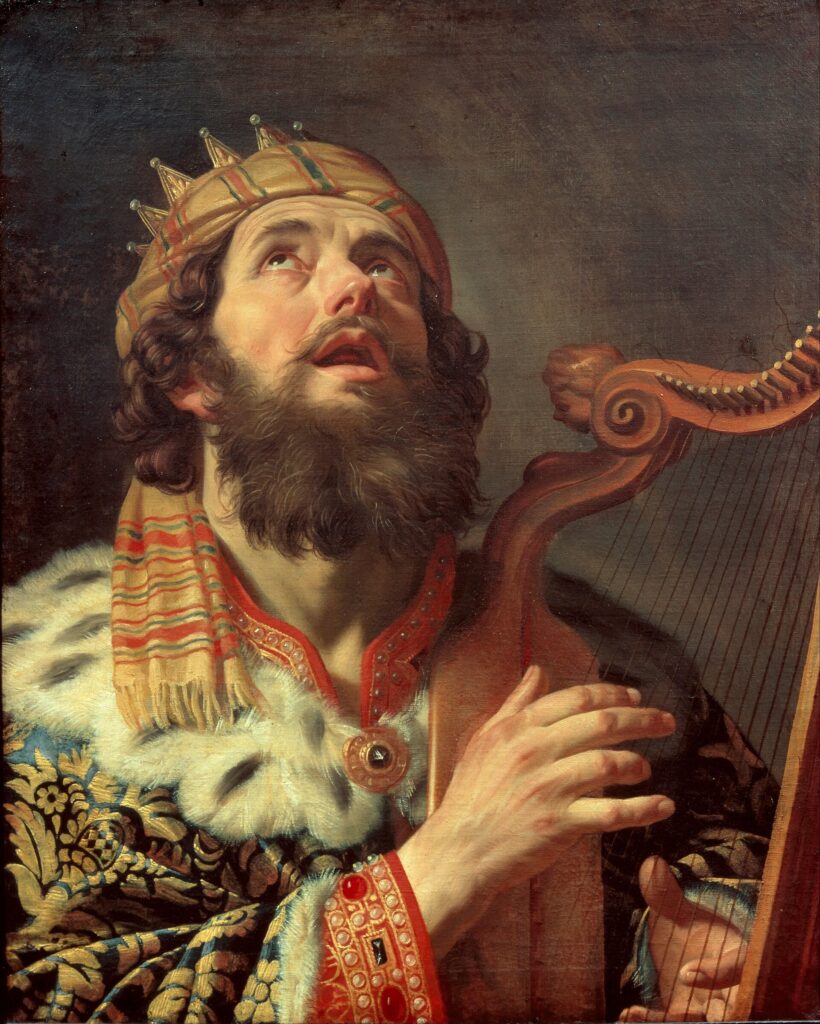
King David is the shepherd, soldier and king of the Hebrew Bible, and his biblical portrayal offers an early example of the warrior poet ideal. The Books of Samuel describe him as a fighter who killed the giant Goliath, a musician who played the lyre for King Saul, and a man who lived as a fugitive before he became king. Almost half of the Psalms carry headings associating them with David, and the Bible preserves his lament for Saul and Jonathan as his own song.
| Lived | Ancient Israel; scholars debate the dates, and the Bible says he reigned forty years |
| Known for | Killing Goliath, uniting Israel, making Jerusalem his capital, and the Psalms |
| The hardship | Life as a fugitive hunted by King Saul, and later a rebellion led by his own son |
| Key work | The lament for Saul and Jonathan (2 Samuel 1), and psalms traditionally attributed to him |
Timeline
The Bible gives no dates in our modern calendar, and scholars debate when David lived, so this timeline follows the order of the biblical story.
| Youth | A young shepherd, anointed by the prophet Samuel as Saul’s successor |
| Rise | Plays the lyre for King Saul, and kills the Philistine champion Goliath with a sling |
| Exile | Hunted by Saul, he lives as a fugitive and twice spares Saul’s life |
| Hebron | After Saul and Jonathan die, he becomes king of Judah and reigns about seven years at Hebron |
| Jerusalem | King over all Israel, he captures Jerusalem and reigns there thirty-three years |
| Crisis | The affair with Bathsheba, the death of Uriah, and later the revolt of his son Absalom |
| Death | After a reign of forty years, he is buried in the city of David |
Who David Was
In the biblical account, David begins as a young shepherd whose heart is devoted to God. The prophet Samuel anoints him as the future king, in place of Saul, after Saul disobeys God’s command concerning the Amalekites. When an evil spirit troubles Saul, his servants recommend David as a musician who can soothe him. In the words of the King James Version, one servant describes David as someone “that is cunning in playing, and a mighty valiant man, and a man of war, and prudent in matters.”
That description, a skilled player and a man of war in the same sentence, is why David appears again and again in discussions of the warrior poet.
His most famous moment comes when the Philistine champion Goliath challenges the army of Israel. David volunteers to fight him, and he explains his confidence by pointing to his work as a shepherd. “Thy servant kept his father’s sheep,” he tells Saul, and he trusts in “the Lord that delivered me out of the paw of the lion.” He kills Goliath with a sling.
Hunted by the King
Victory made David famous, and fame made Saul jealous. In the biblical story, Saul plots to kill him. Saul’s son Jonathan, who loves David, warns him of the danger, and the two men pledge their friendship to each other. David flees, and he lives as a fugitive, moving between places such as Nob, Gath and Adullam. At one point, he settles among the Philistines, Israel’s enemies, at a town called Ziklag, under King Achish of Gath.
It is a long test of patience. David has been anointed as the future king, yet he must run from the man who holds the throne.
How He Endured
Twice, according to the Books of Samuel, David has the chance to kill Saul, and twice he refuses. In a cave at Ein Gedi, he quietly cuts off a piece of Saul’s robe instead of striking him. “The Lord forbid that I should do this thing unto my master, the Lord’s anointed,” he tells his men. When he then calls out to Saul, he leaves the outcome to God: “The Lord judge between me and thee.” In a second account, he slips into Saul’s camp and takes the sleeping king’s spear and water jug, then again refuses to harm him.
The story presents his restraint as a kind of strength. He will not take the throne by murder.
Saul and Jonathan eventually die during a battle with the Philistines. David becomes king of Judah at Hebron, and later king over all Israel. He captures Jerusalem, makes it his capital, and brings the Ark of the Covenant there.
The Bible does not present him as flawless. It tells how he took Bathsheba, the wife of Uriah the Hittite, and arranged for Uriah to be killed in battle, and how the prophet Nathan confronted him for it. Later, his son Absalom leads a revolt against him. Absalom is killed by Joab, against David’s orders, and the king’s grief is recorded in one of the most painful lines in the Bible.
In His Own Words
The quotations below come from the King James Version. The Bible presents these as David’s own words, though how much of them goes back to the historical David is something scholars debate.
Facing Goliath
Facing Goliath, David says, in 1 Samuel 17:45:
“Thou comest to me with a sword, and with a spear, and with a shield: but I come to thee in the name of the Lord of hosts, the God of the armies of Israel, whom thou hast defied.”
What it means: Goliath trusts his weapons. David trusts something larger than himself, and that faith is the source of his nerve.
The Lament for Saul and Jonathan
When word comes that Saul and Jonathan have died, David mourns them both in a song preserved in 2 Samuel 1. It begins:
“The beauty of Israel is slain upon thy high places: how are the mighty fallen!”
What it means: David mourns the king who had hunted him, as well as his closest friend. The lament praises both men, saying “they were stronger than lions,” and expresses no grudge against Saul.
To Jonathan, he says:
“thy love to me was wonderful, passing the love of women.”
What it means: The friendship between the two men was among the deepest bonds of his life, and he says so openly.
Grief and Acceptance
When a child of his dies, David ends his fast and explains why, in 2 Samuel 12:23:
“But now he is dead, wherefore should I fast? can I bring him back again?”
What it means: He fought for the child’s life while there was hope. Once the child was gone, he accepted what he could not change, and returned to living.
The Cry for Absalom
His son Absalom led a rebellion against him and was killed. When the news reaches David, he cries, in 2 Samuel 18:33:
“O my son Absalom, my son, my son Absalom!”
What it means: Even a son who had tried to take his throne was still his son. Victory in the war brought him no comfort.
A Song of Deliverance
Many psalms are headed as psalms of David, though scholars note that these headings were added later, and that no psalm can be credited to him with certainty. Psalm 18 also appears as a song in 2 Samuel 22, where the Bible says David sang it after God rescued him from his enemies and from Saul. It includes a soldier’s image of safety:
“The Lord is my rock, and my fortress, and my deliverer; my God, my strength, in whom I will trust”
What it means: For a man who had lived as a hunted fugitive, safety is pictured in military terms: a rock, a fortress, a deliverer.
Legacy
The story of David has long been admired as literature. Reviewing Robert Alter’s translation of the Books of Samuel, one critic called it the most literary of all the Bible’s narratives. The Bible itself, near the end of his story, records “the last words of David,” closing the life of the shepherd who became king.
In art, the best-known image of David is Michelangelo’s marble statue in Florence, completed in 1504 and standing more than five meters tall. Many scholars read it as showing David before the fight, sizing up the giant.
David in History
How much of David’s story is history is a matter of debate. An inscription known as the Tel Dan stele, found in 1993 and dated to the late ninth or early eighth century BC, contains a phrase that most scholars read as “House of David,” although others dispute that reading. Scholars disagree about the scale of his kingdom, with views ranging from a small chiefdom to a modest state or a small empire. Some modern historians also judge him harshly, describing a ruthless man who used violence to gain power. This profile follows the biblical account, which is the main source for his life.
What David Teaches
Read as a story about endurance, David’s life offers lessons that work far from any battlefield. These are the ones we are training to live by.
Prepare in Small Places
David meets Goliath with skills learned while guarding sheep. The ordinary work done when no one is watching is often what holds up when the big test arrives.
Refuse the Shortcut
In the cave at Ein Gedi, the fastest route to the throne was in reach, and he turned it down. Strength includes the discipline to wait, and to win the right way.
Grieve Openly, Even as a Leader
The lament for Saul and Jonathan, and the cry for Absalom, show a commander who does not hide his loss. Saying plainly what has been lost is part of carrying on afterward.
Accept What Cannot Be Changed
After the death of his child, David stopped fasting, because nothing more could be done. Fighting hard while there is hope, then accepting the outcome, is a discipline in itself.
Further Reading
For readers who want to read the story in full, these are good places to start.
- 1 and 2 Samuel in the King James Version, free to read online
- Robert Alter, The David Story: A Translation with Commentary of 1 and 2 Samuel (W. W. Norton, 1999)
Related Warrior Poets
David appears throughout our guides to the warrior poet tradition.
Frequently Asked Questions
Was King David a Real Person?
Many scholars think so, though they debate how powerful he was. An inscription called the Tel Dan stele, from the late ninth or early eighth century BC, contains a phrase that most scholars read as “House of David,” though some dispute that reading.
Did David Write the Psalms?
Almost half of the Psalms carry headings associating them with David, but those headings were added later, and no psalm can be credited to him with certainty. The lament for Saul and Jonathan, and the song in 2 Samuel 22, are presented in the Bible as his own words.
How Long Did King David Reign?
According to 1 Kings 2, he reigned forty years: seven at Hebron, and thirty-three at Jerusalem.
How Did King David Die?
The Bible says simply that he “slept with his fathers, and was buried in the city of David,” after Solomon had been secured as his successor.